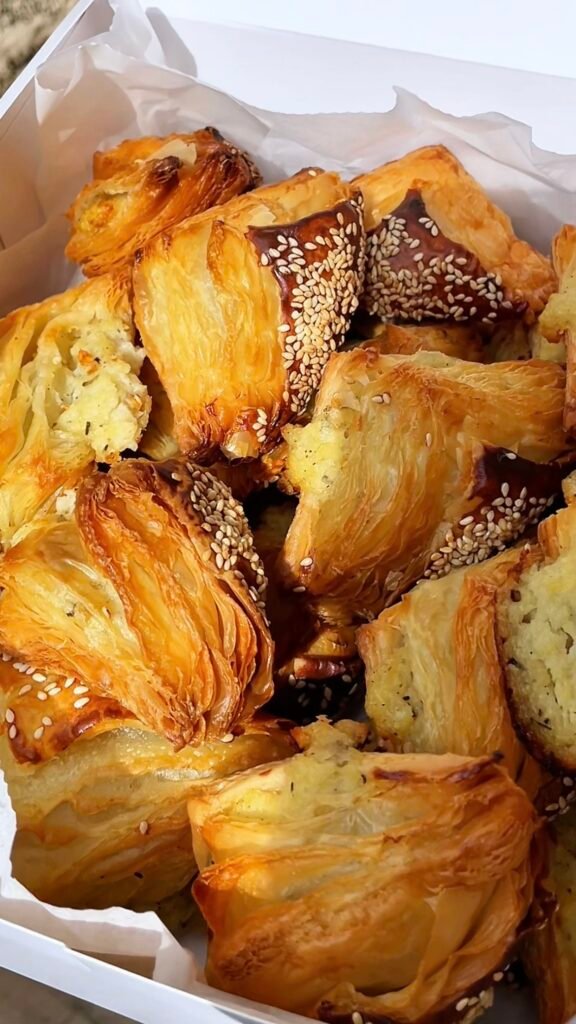
Classic Puff Pastry Potato Burekas

Shavuot is long gone, but these Potato Burekas do not require any special occasion to be made. I’ve previously shared my quick puff pastry recipe on my blog, and today’s the turn to share the classic puff pastry recipe. It is much more simplistic and forgiving than a croissant dough, and doesn’t require prolonged proving stages.
What’s even greater about puff pastry is that even if you mess up a little, you’d still get a marvelous result.
Everything here can be made in advanced, frozen and bake at your convenience.
And, as a bonus, the entire recipe can very easily be made vegan, and I’ve included the relevant substitutes below.
First published:
Last modified:
Classic Puff Pastry Potato Burekas:
Equipment: No special equipment is needed.
Recipe: Makes 16 Medium sized Burekas or 30 Smaller ones
Classic puff pastry dough:
| Ingredient | Amount (g / units) |
| Bread Flour | 500g |
| Cold Water | 225g |
| Salt | 13g |
| Vegetable Oil | 60g |
| Lamination: Butter, or Vegan Butter | 400g |
Potato Filling:
| Ingredient | Amount (g / units) |
| Baking Potatoes (Peeled) * | 430g |
| Milk (or Dairy Free Milk) | 60g |
| Heavy Cream (38%) or Vegan Heavy Cream | 55g |
| Unsalted Butter (or Vegan Butter), Cubed | 55g |
| Salt | 6g |
| Black Pepper | 1/4 tsp |
| Dried Thyme | 1/8 tsp |
| Dried Rosemary | 1/8 tsp |
* In order to get 430g peeled potatoes you would need approximately 540g of un-peeled potatoes.
Egg Wash:
One beaten egg, with little bit of water and a little bit of salt, or, for vegan alternative: soy milk mixed with a little bit of dates syrup (silan)
Preparation instructions:
It is recommended to prepare the potato filling in advanced as it requires some time to chill and set.
Potato Filling:
- Into a medium sized pot, add the peeled potatoes, and fill it with water to cover about 2-3 cm above the height of the potatoes.
- Cook on medium heat, with an open lid, for about 45 minutes, or until an inserted fork easily slides through the potato.
- During cooking, mix together the milk and heavy cream, and microwave them in pulses to warm the mixture (about 60C).
- Strain the potatoes from the water, and puree them using a potato masher.
- Gradually add in the butter cubes, and incorporate using the potato masher.
- After the butter is incorporated, add in all the spices, and in 3 parts, add in the milk mixture, whisking in between with a whisk, until the texture is smooth. Please taste test and correct the seasoning per your personal preference.
- Allow the filling to cool down in the refrigerator a few hours (at least 4) to let it set, preferably overnight. The texture should be pasty, similar to a pipeable cream, and not fluid. Transfer the filling into a piping bag, and refrigerate until use.
For the dough:
Note: When making puff pastry at home, it is highly recommended to work in a cold environment. It is less of a problem during winter, but on summer days you may want to turn on you’re A/C, otherwise the butter will start melting really quickly, which would require refrigerating the dough more frequently in between the folds.
- Into a standing mixer bowl fitted with the dough hook attachment, add the flour and salt and mix them well. Add in the oil and half the amount of water.
- Start kneading on low speed and stream in the remaining water.
- Knead for 10 minutes on low speed until you get a nice and smooth dough.
- Meanwhile, prepare the butter block: Note that each butter block is 200g. Lock the butter in a parchment paper envelope sized 20X20 cm, and flatten it inside. At first, you can smack the butter with a rolling pin until it’s pliable enough to roll it to an even thickness. Refrigerate the butter block until the dough is ready to work with.
- Once the dough has ended kneading, divide it into two parts, about 400g each, cover each one in plastic wrap and let the dough rest for 15 minutes on the counter, at room temperature.
The folding technique described below is for one part of the dough, however the second dough can be worked on in parallel.
- On a lightly floured counter, roll the dough to a rectangle sized 45cm (l) x 20cm (w), placing the butter block right at the center. Close the two extending dough flaps on the butter block and seam them by pinching the dough together with your fingers.
- Elongate the dough to a rectangle sized 45cm (l) x 20cm (w). At first do this by lightly pressing the dough as you move forward in order to flatten the butter block that’s locked inside the dough. Then proceed to rolling the dough with one even pressure forward.
- Make a letter fold.
- Repeat steps 7-8 and do another letter fold. Allow the dough to rest for 15 minutes in the freezer before making the last letter fold according to steps 7 and 8.
- Cover the dough with plastic wrap and let it rest for 30-60 minutes in the refrigerator.
Assembly and baking:
- Preheat your oven to 200C (fan mode ON), with a baking rack placed at the middle shelf inside the oven.
- Take the dough out of the refrigerator, and roll it on a lightly floured counter to a large rectangle sized 45cm (l) x 25cm (w).
- Divide this rectangle to 15 squares sized 8x8cm for smaller Burekas, or 8 squares sized 10x10cm for medium sized Burekas.
- Spray the dough squares with some water, and pipe the filling at the center of each square. Close the dough on itself to make a triangle, and make the edges are touching together (however, do not press them forcefully).
- Place the pastries on a baking sheet lined with parchment paper. Brush the pastries with the egg wash, sprinkle some sesame seeds, and bake for 25-30 minutes.
Notes:
- The dough can be frozen after all folds are completed, or as soon as you’re done shaping your pastries.
- Thawing the dough can be made only from freezer to the refrigerator, for 12 hours. After 12 hours you can continue working on the dough or bake the pastries as per the above instructions.